
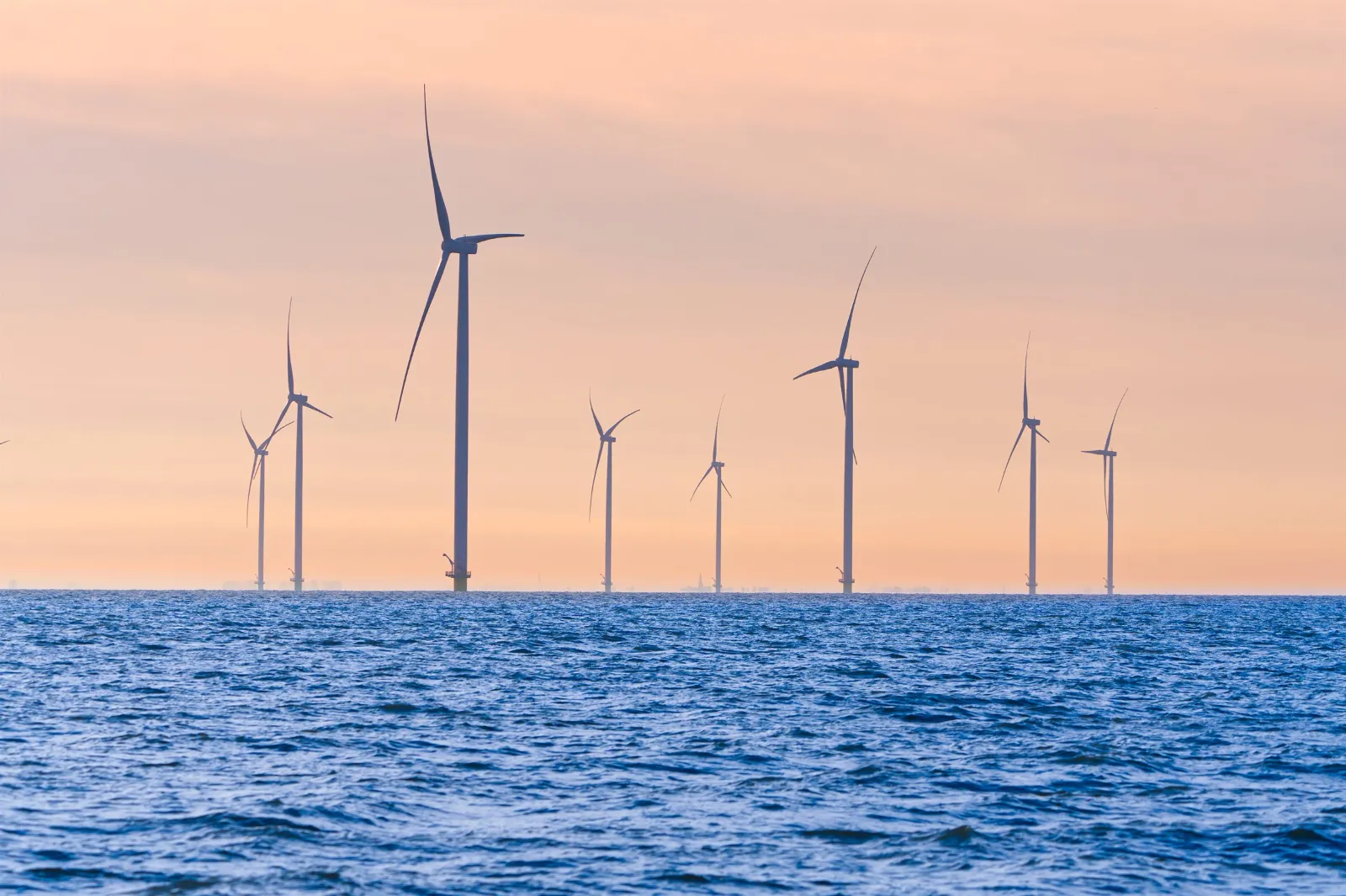
Two of the UK’s largest offshore wind farms now have the money to be built. On Wednesday 11 November 2026, energy company RWE and investment firm KKR committed £12 billion to Vanguard West and Vanguard East, off the Norfolk coast. The government says it believes this is the biggest investment of its kind in UK history. Both wind farms are due to be running by 2030. Nothing changes on your business energy bill today, but projects this size shape what electricity costs in the 2030s.
The facts
- Who: RWE and KKR. The financing includes £1 billion from the National Wealth Fund, the publicly owned bank that invests alongside private money. The government says it’s the fund’s largest offshore wind investment so far.
- What: two wind farms with a combined capacity of 2.8 gigawatts (GW), 50 to 80 km off the Norfolk coast.
- Cost: £12 billion in total. On our own maths, that’s about £4.3 billion for each gigawatt, or £4.3 million per megawatt.
- When: onshore works are already well advanced. Offshore construction is set to begin in early 2027, with both wind farms operational by 2030.
- Jobs: more than 2,400 during construction and operation.
- Output: the capacity to supply the equivalent of around three million UK homes.
Markus Krebber, chief executive of RWE, said the two projects are “strengthening domestic electricity generation and making an important contribution to the country’s long-term energy security”.
Berwick Bank B takes a step forward too
On the same day, SSE named Siemens Energy as its preferred supplier of turbines and offshore substation platforms for Berwick Bank B, a 1.4 GW wind farm about 38 km off the Scottish coast in the outer Firth of Forth.
This one isn’t a final go-ahead. The appointment depends on SSE’s final investment decision, which it expects in late 2027. If that goes ahead, preparatory offshore work could begin in 2028, with turbines installed between 2030 and 2032. SSE says the Siemens Energy work would support 2,677 UK jobs, including 130 new project roles in Glasgow and Montrose.
Berwick Bank B is one phase of a development of more than 4 GW. The government says the full project could become the world’s largest offshore wind farm and meet more than 6% of current UK electricity demand. We covered its planning approval in our story on the Berwick Bank offshore wind farm.
How are these wind farms paid for?
Big wind farms are built on Contracts for Difference (CfDs). The developer is guaranteed a fixed price, called a strike price, for each megawatt hour (MWh) of electricity it generates. When the market price is lower, the generator is topped up. When it’s higher, the generator pays the difference back.
In the latest government auction, the round that Berwick Bank B won its contract in, the average offshore wind strike price was £91 per MWh. STV reported that an industry measure published the same day put the cost of building and running a new gas-fired power station at £147 per MWh.
The top-ups are funded through a levy on electricity bills, including business bills. It’s one of the non-commodity costs, the charges on your bill that aren’t for the energy itself.
Why does it matter that these are being built?
A project of similar size has gone the other way before. Ørsted stopped work on Hornsea 4, a 2.4 GW wind farm with a government contract, because rising costs meant it no longer added up. A contract isn’t the same as a wind farm. A final investment commitment, with the money signed, is the point where a project becomes real.
There are still questions worth asking:
- Can the grid carry it? 2.8 GW landing in East Anglia has to reach the places that use it. That’s why links like Sea Link, the undersea cable between Suffolk and Kent, matter as much as the turbines.
- Will 2030 hold? Offshore construction hasn’t started. The dates are the developers’ own.
- What does it do to the levy? More CfD-backed generation means more electricity paid at fixed prices. Whether that adds to bills or takes money off them depends on where market prices sit against £91.
Our view on grid and generation investment hasn’t changed: we welcome it. More homegrown generation and a stronger network keep prices lower over the long term than relying on imported gas.
What does this mean for your business?
- Nothing changes on today’s contracts. These wind farms won’t generate until 2030.
- Watch the non-commodity side of your bill. CfD costs are one of the charges that sit on top of the energy price. If you’re comparing quotes, check whether those charges are fixed in the price or passed through at cost, because that decides who carries the risk if they move.
- Longer contracts need a longer view. If you’re considering a contract that runs to 2030 or beyond, it will reach the period when this new capacity is due to arrive. Talk to one of our energy experts about how suppliers are pricing those later years.
Talk to our energy experts
Want to understand what’s in your electricity price beyond the energy? Book an appointment with our Energy Team, get a quote, or call us on 01273 914000.