
Business water: compare and switch your supplier
Free to switch, no change to your supply, and we handle it for youMost businesses in England and Scotland can choose who bills them for water. When your current contract ends, it costs nothing to switch, and the water coming through your pipes doesn't change.
Switching only changes your retailer: the company that sends your bill and looks after your account. Your regional water company keeps running the pipes, the treatment works and your supply, exactly as before. We compare retailers for you, check what you're paying and handle the switch, so all you have to do is choose. If you're part-way through a contract, tell us your end date and we'll line the switch up for the right time.
All we need to get started is your postcode and a recent water bill. You don't need to hunt for your SPID (your supply point number): we'll find it for you.

Water deregulation explained
How the business water market works
The business water market in England opened to competition on 1 April 2017, and Scotland's opened on 1 April 2008. Deregulation split the old water company job in two, and around 1.2 million business customers in England can now choose their retailer, with every retailer licensed by the water regulator, Ofwat.
-
 The wholesaler: your regional water company. It owns and runs the pipes, mains and treatment works, and you can't change it, because it's set by where your premises are.
- The retailer: the company that buys wholesale services, bills you, reads your meter and answers your queries. Every retailer needs a licence from Ofwat, and this is the part you can switch.
- The market operator: MOSL runs the market in England and moves your details from one retailer to the next when you switch. In Scotland the Central Market Agency does that job.
Can my business switch?
It depends on which nation your wholesaler is based in, not just where your premises sit. Household customers can't switch; the market is open to businesses, charities and public sector organisations.
England
Every business customer of a water company based wholly or mainly in England can switch. There's no minimum usage, so a single café qualifies just as a factory does.
Wales
Only sites using at least 50 megalitres (50 million litres) a year can switch. The same rule applies to premises in England that are supplied by a Wales-based water company.
Scotland
All non-household and public sector customers have been able to choose since 1 April 2008. Scottish Water stays the wholesaler, and retailers are licensed by the Water Industry Commission for Scotland.
These are the eligibility rules as of 13 October 2026. Not sure which applies to you? Send us a bill and we'll check for you.
What's on your business water bill
A business water bill is a bundle of separate charges. Your regional wholesaler publishes its charges in a scheme each year, and your retailer buys those services and packages them into the bill you pay, along with its own billing and customer service. Every bill has to show your SPIDs, your tariff, how the bill was worked out and your retailer's contact details.
The charges that make up your bill
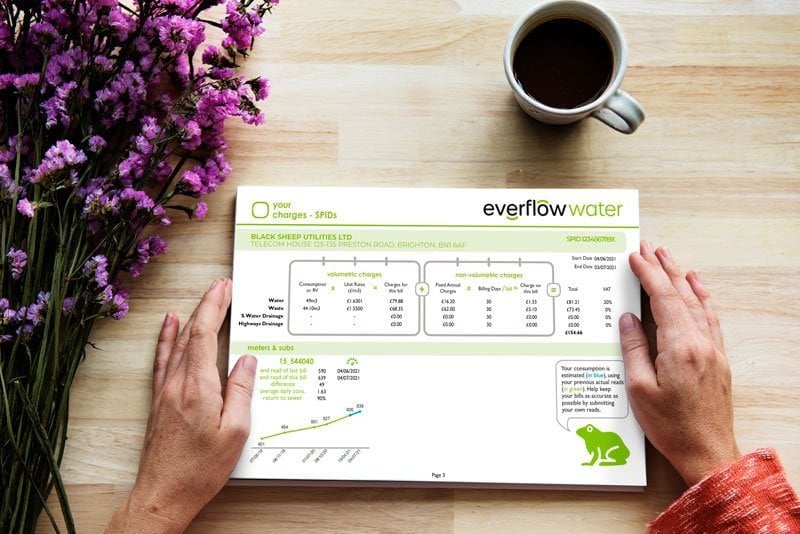
- Water supply: the water you use, plus a fixed or standing element.
- Wastewater (sewerage): taking away and treating the water that leaves your site.
- Surface water drainage: rainwater running off your roofs and yard into the public sewer, worked out differently by different wholesalers, for example in bands by site area or by the size of your meter pipe.
- Trade effluent: a separate charge if your business discharges waste from its processes into the sewer.
Metered or unmetered

If you have a meter, you pay for what it records. If you don't, the wholesaler's charge is worked out from the rateable value of your premises plus a fixed charge, so it has nothing to do with how much you actually use. Yorkshire Water's 2026/27 wholesale charges, for example, use both methods. Not sure which you're on? We'll tell you from your bill.
Has your water bill ever jumped when nothing on site changed? That's exactly what our bill validation is for: we check each bill against your agreed rates and recorded usage, and take up any error with your retailer.
How switching works and how long it takes

- Tell us your contract end date: switching works when your current contract has ended or is about to, so we time it for you.
- Send us a bill: we read your usage, charges and SPIDs from it.
- We compare retailers: you get a written selection of the options from suitable retailers that best suit your business.
- You choose and sign: the decision is always yours.
- The new retailer applies: it arranges the transfer and contacts your current retailer.
- You're switched: usually six to twenty business days after the transfer application.
Switching costs nothing and your service won't be interrupted. Your old retailer sends a final bill and the new one takes over from there. Still in contract? Tell us your end date and we'll be in touch well before it, ready to switch you at the right time.
What happens if you don't switch
Your water keeps flowing, and you stay with your current retailer on the terms you have now, which are rarely the best on offer. If you're a smaller user in England, using less than 0.5 megalitres a year, and you haven't switched or otherwise engaged with the market, Ofwat's business retail price caps protect your price.
Protection isn't the same as a good deal, though. Your retailer won't always offer you its best price, and if you're a bigger user there's no cap at all. We'd always look at what's on offer before simply staying put, and a written comparison from us shows you whether moving is worth it.
Your protections, with us in your corner
Ofwat's rules protect you too. A micro-business can't be rolled onto a new contract automatically without its written consent, your old retailer must send a final bill within six weeks of a switch, and every retailer must send at least one accurate bill a year.
If something goes wrong with a bill or your service, tell us and we'll take it up with your retailer for you. A retailer should give a full response to a written complaint within 10 working days, or pay you £20 automatically under the Guaranteed Service Standards. In the rare case it still isn't sorted, CCW can take up complaints from business customers in England and Wales, and in Scotland the Scottish Public Services Ombudsman handles complaints that can't be resolved. We'll support you all the way.
You'll often hear from us before you need to think about it: we call our customers about their water when a contract is coming up for renewal, so nothing rolls on unnoticed. We'd also always advise against paying far in advance, because credit for services not yet delivered might not be recoverable if a retailer fails. As our customer, you have us to deal with the retailer on your behalf.
What's changing in the water sector
Big changes are on the way. On 21 July 2025 the Independent Water Commission, chaired by Sir Jon Cunliffe, recommended replacing Ofwat with a single regulator for England, and an Ombudsman for Water built on CCW.
On 19 February 2026 the government committed to abolishing Ofwat for a new single regulator, a Water Ombudsman whose decisions are legally binding, and a supplier of last resort so businesses aren't left stranded if a retailer leaves the market. It also welcomed the planned phasing out of falling block tariffs by March 2030.
As of October 2026, the new regulator hasn't been named and no start date has been set. Until it is, Ofwat and today's rules stay in place, so nothing changes in how we compare and switch your water when your contract is up for renewal.
Do you need a broker? Yes, and here's why
Comparing retailers, making sense of the charges on your bill, timing a switch around your contract end date and chasing a retailer when something goes wrong all take time and know-how. That's exactly what we're here for. We compare retailers for you, check your bill and charges, handle the switch and deal with the retailer whenever something needs sorting, so you get time back and someone in your corner.
Using less water
The cheapest water is the water you don't use. A few simple habits make a real difference on a metered site:
- Read your meter after closing and again before opening: if it has moved with everything off, you may have a leak.
- Fix dripping taps and running toilets: small leaks run all day, every day.
- Check your bill against your meter: estimated reads can drift a long way from reality.
- Know your site: if you're unmetered or your surface water charge looks high for your site, ask us to take a look.
Keeping an eye on costs? We've covered the April 2026 water rate increase, drought warnings and hosepipe bans, spotting a suspicious bill and the Ofwat overhaul, so you know what's coming.
OUR TRUSTED SUPPLIERS

Find out more about the retailers we work with: Everflow, Wave, Water Plus, Business Stream, Pozitive Water, SES Business Water and Yu Water.
Frequently Asked Questions
When was the business water market deregulated in England?
What does business water deregulation mean for my company's water costs?
Can a small business switch water supplier?
How long does it take to change business water supplier?
Can I switch business water supplier in the middle of a contract?
Do I need my SPID to switch?
Can my Scottish business choose its water supplier?
Is a water supplier the same as a water retailer?
How Black Sheep Utilities can help
As an independent business energy and water broker, we take the leg work out of business water:
- A written comparison: the options from suitable retailers that best suit your business, so you can see the choice clearly.
- The switch, handled: we arrange the contract once you've signed it, and the retailer does the transfer.
- Every site in one place: we keep contract end dates for all your sites on record and send renewal reminders well ahead.
It doesn't matter if you don't use us for energy. Send us a recent water bill or get a quote, and we'll take it from there. No pressure, just straightforward advice.