

With the price of Wholesale Energy an almost daily news story in 2021, it’s worth remembering that in September 2021 almost 60% of your energy bill was made up of non-commodity costs.
Some of these non-commodity costs will be itemised as additional charges on your bill but the majority are built into the unit rate and standing charge you pay rather than shown separately, the exact incorporation of which will vary depending on your supplier.

What can I see on my bill?
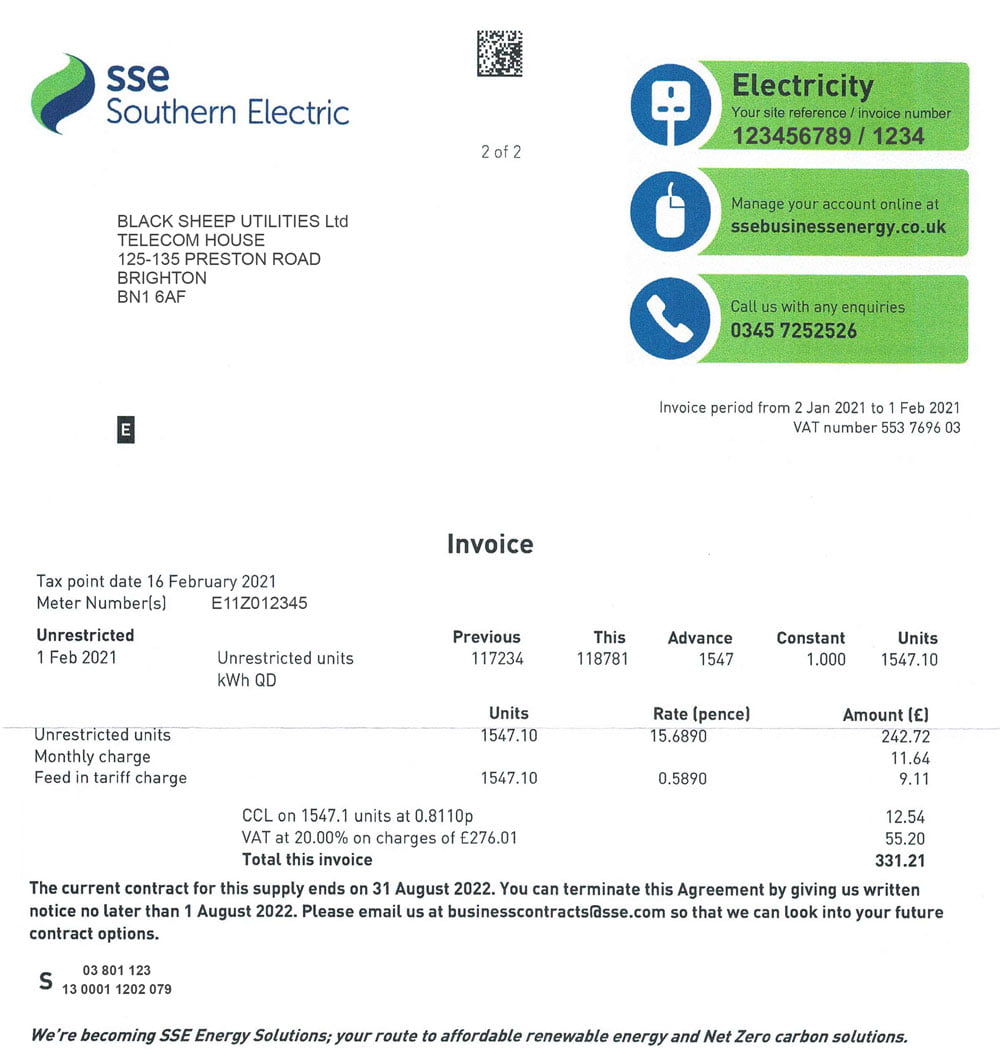
Usually, the only non-commodity cost you will see itemised on your bill will be the Climate Change Levy (CCL), although some suppliers itemise others too.
The main exception to this is for businesses on ‘pass through’ contracts which have all non-commodity costs itemised on their bills. Although itemised the actual costs will be forecasted which are then later reconciled.
For the majority of business customers all other non-commodity costs will be wrapped up in your unit rate and standing charge you pay.
Use of System Costs
Delivering energy to customers requires infrastructure and management which are divided into four categories that make up the non-commodity costs you pay.
These are the ‘Transmission Network Use of System’ (TNUoS), the ‘Balancing Services Use of System’ (BSUoS), the ‘Distribution Use of System’ (DUoS) and Loss charges.
Renewable Subsidies
Currently, there are three renewable subsidies included in your bill as non-commodity costs – ‘Contract for Difference’ (CFD), ‘Renewables Obligation’ (RO) and ‘Feed-in Tariff’ (FiT).
Taxes and support levies
There are several additional taxes and support levies which are also included in your non-commodity costs. These include the ‘Climate Change Levy’ (CCL), and the government schemes ‘Capacity Market’ (CM) and ‘Assistance for Areas with High Electricity Distribution Costs’ (AAHEDC).
VAT although an additional tax, where applicable, isn’t normally included as a non-commodity cost as it’s a general taxation mechanism.
Catalyst for change
The 2021 to 2022 energy crisis saw the wholesale cost of energy soar which, in turn, resulted in a change to the proportional costs of your energy bills. In September 2021 roughly 60% of bills were made up of non-commodity costs but the rise in wholesale energy prices that followed caused a shift in balance whilst also acting as a catalyst for non-commodity cost increases.
The energy crisis hasn’t just caused an increase in wholesale costs it, combined with other geopolitical factors, as well as climate change promises and obligations has led to a further drive towards self-sustainability which will require massive amounts of investment in infrastructure.
As the industry and government look for funding for this renewable self-sustainability it’s non-commodity costs that will be increased to deliver.
Whatever the future holds for wholesale energy costs, non-commodity costs are expected to keep rising over the next few years.
Want more information about non-commodity costs?
If you’re not sure of the difference between your ‘TNUoS’ and your ‘CCL’, you are not alone. Check out our breakdown below for an overview of each of the different non-commodity costs.
Standing Charges: What You’re Paying For
Your standing charge is the fixed amount you pay for having a supply. You pay it every day, even on days you don’t use any energy, and it can vary by where you are, how you pay, the fuel and the type of meter. Like the rest of your energy price, it’s built from the same costs that sit behind the price cap and standing charges for households: wholesale energy, network costs for the pipes and wires, policy costs for government schemes, suppliers’ operating costs, profit and an allowance for risk.
For a sense of scale, here are the household figures. From 1 October to 31 December 2026, the price cap sets an average electricity standing charge of 54.83p a day and a unit rate of 26.32p per kWh for Direct Debit customers, with no VAT on electricity from 1 October 2026 to 30 June 2027. For gas, it’s 29.68p a day and 7.97p per kWh, including VAT at 5%.
Business energy works differently. There’s no price cap for business contracts, which means there’s real value in shopping around at renewal: we compare prices from suitable suppliers for your sites and find you a fixed price that suits you. On a fixed-rate business contract, the unit rates and standing charges are set for the length of the deal. Some contracts do let the supplier change the rate during the term, though, so we look closely at which charges are fixed and which can be passed through when we compare offers for you.
If a bill does go up when you haven’t used any more, send it to us. Our bill validation checks each bill against your agreed rates and recorded consumption, and we take up any error with the supplier.
Network Charges: TNUoS, DUoS, BSUoS and Losses
These are the costs of getting electricity from the power station to your door.
- TNUoS (Transmission Network Use of System): These charges recover the cost of installing and maintaining the high-voltage transmission system in England, Wales, Scotland and offshore. Tariffs depend on the zone you’re connected in, and the National Energy System Operator (NESO) publishes them each year by 31 January to take effect on 1 April. If you’ve got half-hourly metering, your charges are set by triads, the three half-hour periods of highest demand on the system. TNUoS is also a big reason standing charges have risen.
- DUoS (Distribution Use of System): These cover the cost of running and maintaining the local networks between the transmission system and your premises.
- BSUoS (Balancing Services Use of System): These pay for the day-to-day running of the transmission system, including keeping supply and demand balanced. From April 2023, NESO recovers them solely from final demand, so from consumers rather than generators, and sets them as a fixed tariff in advance.
- Losses: The electricity that goes missing as it travels through the wires. Line loss factors scale the energy you use to allow for it.
Government Schemes Funded Through Your Bill
A second group of charges pays for government schemes. Each one is an obligation on electricity suppliers, and they’re built into the cost of the energy you buy.
- Contracts for Difference (CfD): Low-carbon generators are paid a flat, indexed rate for their electricity over 15 years, based on the gap between a “strike price” and the market price. The cost is met through the CfD supplier obligation, a compulsory levy on electricity suppliers.
- Renewables Obligation (RO): It places an annual obligation on suppliers to present certificates for each megawatt hour they supply. It began in Great Britain in 2002 and closed to new generating capacity on 1 April 2017.
- Feed-in Tariffs (FiT): Payments to owners of small-scale generation, such as solar panels, for the electricity they export. The FIT scheme closed to new applicants on 1 April 2019, and its costs are spread across all licensed electricity suppliers.
- Capacity Market (CM): Payments to reliable sources of capacity so they’re there when needed. Costs are invoiced to suppliers monthly, based on their share of net demand.
- AAHEDC: Assistance for Areas with High Electricity Distribution Costs keeps distribution charges down in the north of Scotland, which as of October 2026 is the only area that receives it. NESO recovers it through a charge on all suppliers.
On a fixed-rate contract, these costs are part of the unit rates and standing charge you agree. How a supplier prices them can make as much difference as the headline rate, so we look at both.
Climate Change Levy: The Tax You Can See
The Climate Change Levy (CCL) is a tax on the energy businesses use. You pay it if your business is in the industrial, commercial, agricultural or public services sectors. Domestic users, businesses that use small amounts of energy and charities engaged in non-commercial activities don’t pay the main rate.
From 1 April 2026 to 31 March 2027, the CCL main rates are £0.00801 per kWh for both electricity and gas, rising to £0.00827 per kWh from 1 April 2027. If you hold a climate change agreement, you get a 92% discount on the electricity rate and 89% on gas.
Picture a workshop using 100,000 kWh of electricity a year. At the 2026 to 2027 main rate, that’s around £801 of CCL before VAT on business electricity is added on top, so you want the right rate or exemption applied every time. We check that for you on every bill.
“Sound complicated? Don’t worry, it is. But not to us here at Black Sheep.”
What This Means for Your Business
Gas prices carry network and policy costs too. For both fuels, a low unit rate on its own won’t tell you what a contract will really cost. The standing charge, which charges are fixed and which can be passed through, and whether CCL is applied correctly all change the total.
That’s where we come in. For your business electricity and business gas, we compare prices from suitable suppliers and present the options that best suit your business, so you’re never weighing up a headline rate on your own. We always advise arranging your next contract as early as possible, normally 12 months before your renewal date, so there’s time to look at the whole price and take advantage of forward pricing.
How Black Sheep Utilities Can Help
As an independent business energy and water broker, we deal with this side of energy every day:
- Written comparisons: We compare prices from suitable suppliers for your sites and present the options that best suit your business, charges and all.
- Contract management: Our retentions team keeps your end dates on record and sends renewal reminders well ahead.
- Multi-site accounts: We can link related companies and billing entities so all your sites are managed together.
Final Thoughts: Look at the Whole Bill
The unit rate is only the start of the story. Standing charges, network costs, government schemes and CCL all shape what you really pay, and we’ll make sense of them for you. The easiest place to start is your latest bill: send us a recent bill and we’ll go through your standing charge and the other charges with you. If you’d rather talk it through, call our Energy Team on 01273 914000 or book an appointment.