
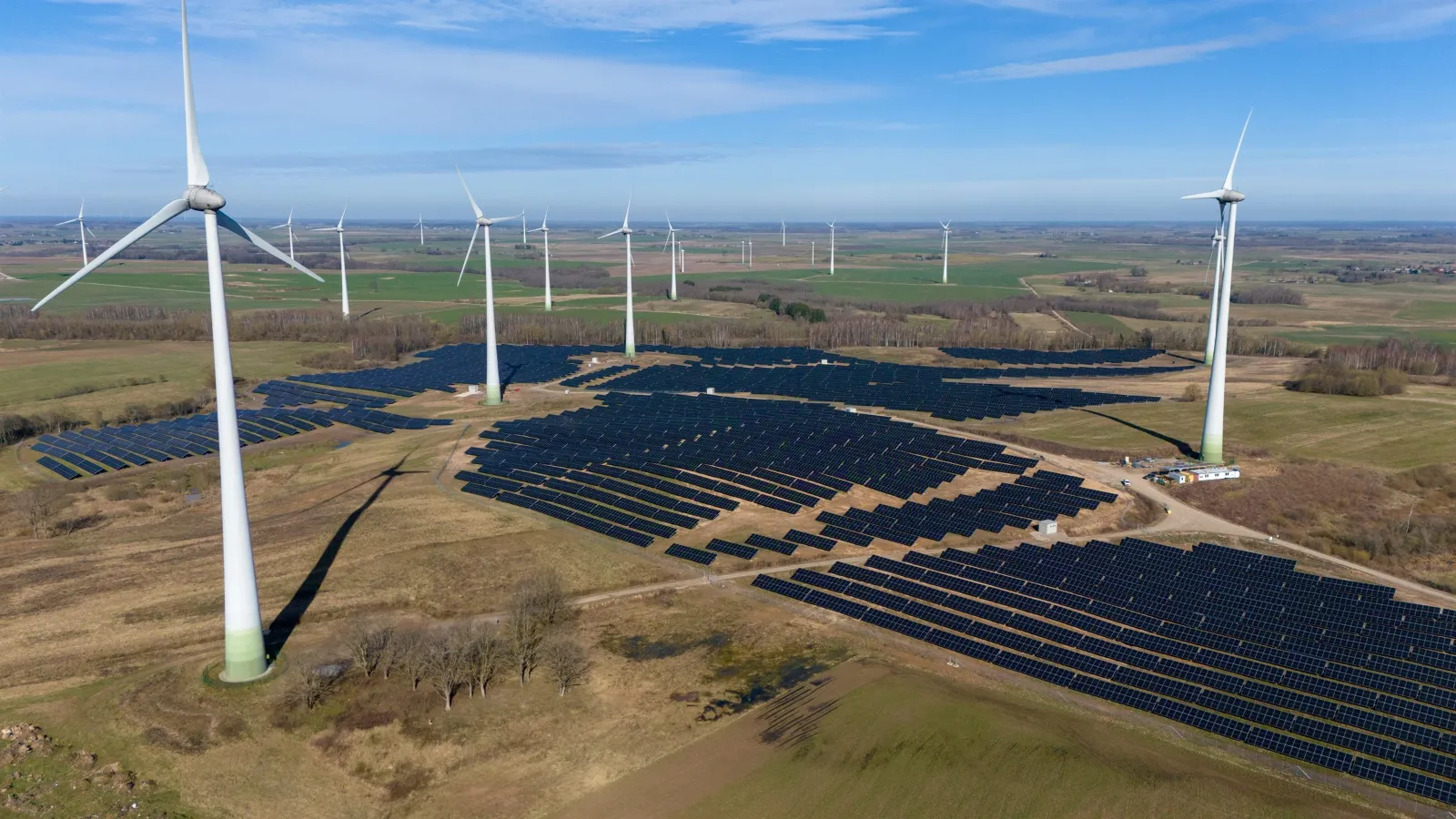
The government approved two large solar farms on Tuesday 27 October 2026. Great North Road Solar and Biodiversity Park, near Newark in Nottinghamshire, can export up to 800 megawatts (MW), which Solar Power Portal reports makes it the joint largest solar farm approved in the UK. Frodsham Solar in Cheshire is smaller, but it includes a direct electricity connection to nearby businesses. Neither changes your business electricity bill today. Both add to the homegrown power that sets prices in the years ahead.
Great North Road: the facts
- Who: Elements Green Trent Limited.
- Where: north-west of Newark-on-Trent.
- Size: permission to export and import up to 800 MW. Solar Power Portal reports it is the second 800 MW solar farm to be approved, level with Springwell.
- Battery: a 440 MW battery energy storage system, holding 880 megawatt hours, according to Solar Power Portal. A battery lets a solar farm store power at midday and sell it in the evening.
- Output: the developer says enough for approximately 400,000 homes.
- Timeline: application submitted 27 June 2025, examined over six months, recommendation sent to the Energy Secretary on 28 July 2026, consent granted 27 October 2026. The developer anticipates construction “will begin around 2027”.
- Cost: the developer hasn’t published one on the pages we read, so we can’t give a cost per megawatt.
The Planning Inspectorate says this was the 117th energy application it has examined out of 185, and that the examination was completed within the legal time limit.
Frodsham Solar: the facts
- Who: Frodsham Solar Ltd, owned by Cubico Sustainable Investments.
- Where: near Frodsham, Cheshire, next to the River Weaver.
- Size: the government’s decision describes a generating capacity above 100 MW. The developer anticipates 130 MW, with up to 100 MW exported to the local network run by SP Energy Networks.
- Battery: a battery energy storage system is included.
- Output: the developer says about 40,000 homes.
- Jobs: the developer says more than 100 full-time equivalent jobs during construction.
- Community fund: in the region of £65,000 a year.
- Nature: about 60 hectares set aside to improve habitat for birds.
- Timeline: early works and surveys next year, before the main construction period.
On our own maths, the two decisions add up to at least 900 MW of approved solar capacity and, on the developers’ figures, power for around 440,000 homes.
What’s different about Frodsham?
The government’s decision includes “a private wire electricity connection to nearby businesses”. A private wire is a cable that runs straight from a generator to a customer, without going through the public network. The site sits beside an industrial area, and the developer says the solar farm will supply “both households and businesses”.
The developer hasn’t published terms, a price or a date for it, and the main construction period hasn’t started. It isn’t something to plan your next contract around. Arrange that on what suitable suppliers are offering now.
The questions worth asking
We welcome new generation. More homegrown power, and the network to carry it, keeps prices lower over the long term than relying on imported gas. There are still fair questions:
- Can the grid take it? Solar Power Portal notes that many developers want to build in the East of England, where grid capacity is available, and that this has drawn “widespread public objection”. Whether the lines there can carry every project that wants to connect is the question.
- What does midday solar do to prices? Solar generates most when the sun is high. Batteries like the ones planned at both sites move some of that power to the evening peak.
- When will they generate? Consent isn’t construction. Great North Road has to meet the conditions of its consent first, and says it will publish its construction programme “once confirmed”. We saw how far consent can be from a finished project when work stopped on the Hornsea 4 wind farm.
- Who pays? Neither developer has said on the pages we read how the project will be funded, or whether it will seek a government-backed fixed price. We explained how those contracts work, and how they reach your bill, in our story on the £12 billion Norfolk offshore wind farms.
What does this mean for your business?
- Nothing changes on today’s contracts. Neither solar farm has started construction.
- Time of day is going to matter more. More solar means more power available in the middle of the day. With half-hourly settlement, where electricity is billed on your use in each half hour, a business that can use more power in the middle of the day can be priced for it. Our MHHS guide for UK businesses explains how.
- You don’t need an 800 MW neighbour to use solar. Panels on your own roof cut what you buy from the grid. We’ve set out the case in our piece on rooftop solar in the UK, and our team can help with solar power for your business.
Talk to our energy experts
Want to know how your business could be priced for when it uses power, not just how much? Book an appointment with our Energy Team, get a quote, or call us on 01273 914000.